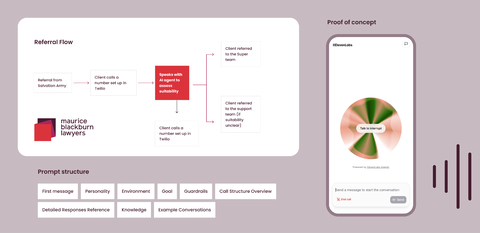
Portable worked in deep partnership with Maurice Blackburn over four focused sprints to design and deliver a functional proof of concept AI voice assistant. The assistant’s role was to screen referees in real time, assessing their eligibility for an insurance claim and helping to speed up the onboarding process. The concept was developed as a fully functioning prototype, capable of live operation, rigorous testing, and validation with real users.
Sprint 1: Define the experience
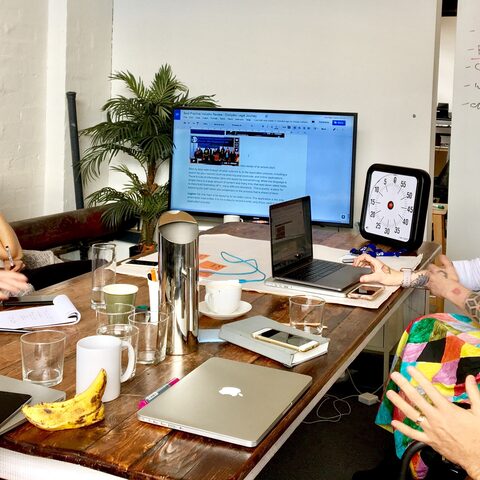
We began with collaborative workshops to:
- Map the eligibility and escalation flow
- Align on legal and operational constraints
- Assess and select suitable AI tooling
We chose a modular stack with Twilio (call handling), ElevenLabs (voice AI), and Azure AI Foundry (LLM), prioritising speed, data security, and cost control.
Sprint 2: Design the experience
We ran a service design workshop to locate the AI agent within the broader client journey and legal context. We documented scripts, escalation protocols, edge cases, and tone-of-voice requirements. This fed directly into the system prompt design, adapted to the sensitive legal context.
We also designed a preliminary evaluation framework focused on:
- Accuracy of eligibility screening
- Empathy and conversational clarity
- Referral and escalation performance
- Data handling and safety compliance
Sprint 3: Build the assistant
During the build phase, we implemented the end-to-end call flow that included:
- Real-time speech recognition, text-to-speech, transcript generation, and structured post-call outputs.
- A lightweight service to process the post-call event that parsed the call summary, identified the relevant team (support vs. superannuation), and triggered email notifications.
This architecture kept the proof of concept self-contained, without requiring integrations with Maurice Blackburn’s production systems, while still delivering functional outcomes.
We established an evaluation framework to provide clear measures for assessment and testing. This included criteria such as:
- Accuracy & Reliability
- Did the agent apply criteria correctly (e.g., make proper referrals)?
- Was the information consistent across similar calls?
- Comprehensibility & Communication
- Did the conversation prompts gather the necessary information?
- Was the agent clear and empathetic in responses?
- User Experience (UX)
- Did it guide users smoothly toward referral or claim steps?
- Was the call length efficient, thorough but not burdensome?
- Safety & Compliance
- Did it escalate edge cases correctly to human support?
- Did it avoid giving legal/financial misguidance?
Our initial testing confirmed that the AI assistant could apply eligibility rules accurately and communicate with clarity and empathy. It performed particularly well in identifying and referring employment law queries and maintained compliance by avoiding the provision of legal advice, instead clarifying service limitations such as operating on a “no win, no fee” basis.
Testing also flagged some unintended behaviours from the agent; the agent occasionally strayed off-topic, mispronounced key words and numeric sequences, and advanced through conversations before callers had finished speaking.
To mitigate these behaviours, we introduced stricter prompt constraints, reworked the dialogue flow, and added escalation protocols for moments of distress. Rather than treating these issues as edge cases, we treated them as design signals; evidence of how real-world complexity needs to be built into AI systems from day one. That mindset allowed us to fix what wasn’t working, without compromising the core function or safety of the experience.
Sprint 4: Tune and evaluate
We evaluated the agent through both real and simulated calls, including high-stakes edge cases. Each test conversation was scored against evaluation metrics, enabling rapid benchmarking of prompt changes and assistant behaviours. This functionality not only provided key insights during testing but could also be replicated for ongoing evaluation of the agent as it matures.
Our layered safety model included:
- Prompt engineering with explicit escalation rules and fallback responses.
- Guardrails provided by Azure AI for risk filtering.
- System-level controls in ElevenLabs to ensure transcripts, recordings, and data were retained securely.
Final testing was conducted and the previous issues no longer presented. The agent performed well on all tasks and continuously responded to off topic conversations by guiding the caller back to its role as an automated voice agent with a warm and acknowledging response. Callers, whether eligible or ineligible, were directed to the correct paths, and key information was captured and directed to the relevant Maurice Blackburn team