Justice
From the first online intervention order to a national dispute resolution platform, twenty years rebuilding how justice reaches people.

From the first online intervention order to a national dispute resolution platform, twenty years rebuilding how justice reaches people.
Portable has been working to improve access to justice since 2012, delivering hundreds of projects for courts, legal aid services, and the people trying to find their way through the legal system. We combine research, design, and technology to build services that meet people where they are, from giving victims a voice in the coronial process to making bail information easier to understand.
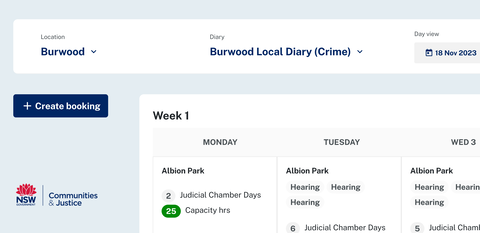
eDiary replaced a paper-based court bookings system with a secure digital platform, now live across three NSW pilot sites, that integrates with legacy systems like JusticeLink instead of working around them. For court staff, that means faster, more accurate bookings and a lighter administrative load; for NSW Department of Communities and Justice (DCJ), it's a system built to be maintained and expanded well beyond launch, after previous attempts to solve this problem hadn't succeeded.

This project gives victims of crime three separate chances to give feedback, before, during and after their matter, so their experience is captured while it's still fresh enough to act on, rather than arriving too late to matter. For the Office of Public Prosecutions, it created a systematic, ongoing way to track and improve how it supports victims, instead of relying on ad hoc or anecdotal feedback.
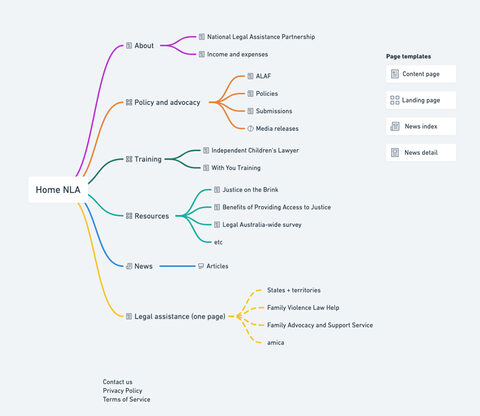
New websites and a learning management system gave NLA and ICL staff a way to manage content themselves and gave legal professionals seamless access to accreditation training, replacing outdated systems that were holding back day-to-day service to vulnerable communities. Website sessions are up 3,000% with 28 seconds added to average engagement time, meaning more of the parents, guardians and families who rely on these services are finding what they need.
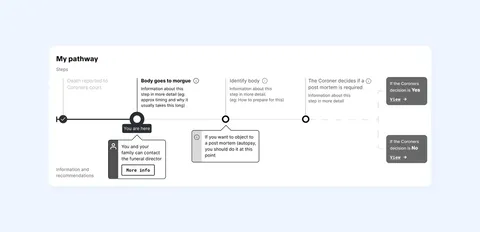
This project gave grieving families interacting with the coronial process a set of grief-informed design principles built specifically for that context, rather than generic government service design, along with a tested prototype direction for a future digital solution. For the NSW Department of Communities and Justice, it means any future solution starts from evidence about what families actually need at one of the most distressing points of contact with the justice system.
Utilising AI to simplify the legal complaint process, Portable and the National Justice Project collaborated on an innovative technological tool that empowers Australians in their pursuit of justice.
Read moreDiscover how Sweep's wage compliance platform evolved from BRII-funded innovation to market-ready solution. Just launched publicly, learn why CTOs and business leaders are watching this breakthrough in fair pay technology.
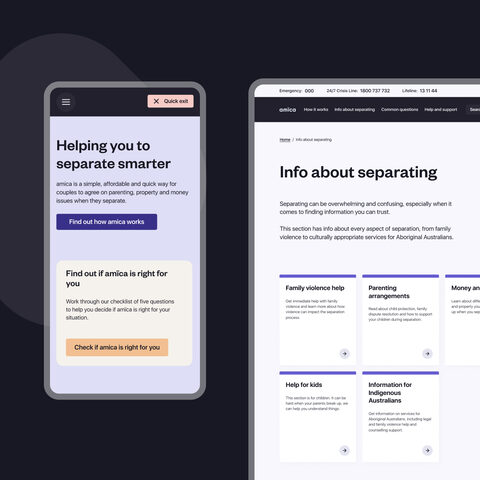
Read moreOur work with the Legal Services Commission of South Australia over 10 years, exploring user needs and iteratively designing an online dispute resolution tool. amica guides former partners towards an amicable resolution of family law issues.
Read moreExplore how Portable's Civily platform builds on years of experience with amica to deliver a scalable, ethically designed family law tool. Learn how this model in transforming access to justice and what it means for the future of public service.
Read moreHelping users navigate the complex and often intimidating justice system, from beginning to end.
Read onCollaboration is at the heart of all that Portable does. Let us know what you're working on and how you envision us partnering.