Beautiful, intricate, completely bespoke
We are entering the era of beautifully intricate, completely bespoke and grand software that allows us to achieve all that we want as individuals and businesses and it’s going to be great and magnificent. And when I say great, I don’t mean for a handful of companies in San Francisco, and not great in the abstract way that technology people say things are going to be. Great for the court registry, the community health service, the regional council and the people who depend on them. After twenty years of building software for government and the community, I think we are finally about to be able to make the thing that fits, for the people who need it, at a cost they can afford. We are entering the era of beautifully bespoke software.
In my role at Portable I’m continually taking coffees and talking to people across the whole technology spectrum, from accelerating start-ups to leaders of truly inspiring public services across Australia and the United States. The conversation is non-stop about AI and the way it is or might be changing their sectors. In a single day I might uncover multiple futures that are at odds with each other. Someone will bring up Dario Amodei, the Anthropic chief executive, warning that entry-level positions in finance, consulting and technology could disappear within one to five years because the systems that once worked at the level of a high school graduate now work at the level of a college graduate. Another will point out that it took mobile banking 72 months to reach an adoption level that generative AI reached in 11. In every roundtable on AI that I attend, the graduate question comes up. Someone says the word "hollowing". And then we move to the next agenda item, which is usually about guardrails, and everyone agrees we should have some. Yep, guardrails are so in vogue.
The true reality that sits underneath this, regardless of whether we like it or not, is that the software era we grew up in is ending. It’s truly in its dying days and you can either be terrified by it or embrace it, but either way we are not going back. It doesn’t feel like that right now for everyone and I want to spend some time talking about why this dissonance exists, why we are stuck looking back.
Why it doesn't feel like it
Right now it feels like a lot of demos, a lot of pilots that never quite leave the pilot stage, and a lot of very confident people on stage. If you work in a department or a community organisation, it probably feels like being sold to. The tools are impressive for about twenty minutes and then you hit the edge of what they can do inside your actual environment, with your actual data, under your actual procurement rules, and you go back to the spreadsheet.
That is what the early stage of every technology shift has felt like. I have been doing this long enough to have lived through a few of them. When we started Portable, building a web application meant you hand-rolled almost everything. There was no cloud to speak of. You managed your own server, you wrote your own authentication, you wrote your own payment handling, and if you wanted a map on a page you called someone who knew someone who’d done map stuff before. The first wave of what we would now call software as a service was clunky and expensive and mostly aimed at large companies in the United States. Nobody in a government department was going to touch it.
And then, quite quickly in hindsight and quite slowly in the living of it, the plumbing got better. Infrastructure became something you clicked rather than something you racked. Frameworks matured. The cost of standing something up fell by an order of magnitude, and then another. The software did not get more generic. It got more specific. Because the plumbing was handled, people could spend their time on the part that actually mattered, which was the problem in front of them and the people living with it.
We are at the clunky, expensive, sold-to stage again. The models are extraordinary and the surrounding plumbing is immature. Context is hard to carry across systems, the governance is being invented in real time, and the gap between a demo and a thing you can rely on in production is wide. I do not want to pretend otherwise, and I have written before about the discipline that gap requires. But I have seen this curve before, and I know which direction it bends, regardless of whether or not the AI market busts.
If you want a single person to stand in for that curve, take David Heinemeier Hansson. I wrote about DHH and Jason Fried a few years ago, with some disappointment, but he’s highly revered in engineering circles. In his first long conversation with Lex Fridman in mid 2025 he was the arch sceptic. "I don't let it [AI] drive my code," he said. "You learn with your fingers." He described AI-generated code as a game of Whac-A-Mole making the mistakes junior programmers make. Then, in August this year, he sat down with Fridman again for five hours and said he would now rather receive an agent-written pull request on one of his projects than a human one! "If there is one programming language more beautiful than Ruby," he told him, "it is the English language." He said he had gone from being excited about the agent moment to being delirious. Fourteen months. That is how fast the plumbing is moving. And in the meantime, I fully expect the tools my own team uses to change hands four or five times in the next twelve months, which is exactly what the early stage of a shift feels like from the inside.
Bespoke
For most of my working life, the economics of software have pushed everyone towards the generic. If building a thing is expensive, you build it once and sell it to as many people as possible. That is the entire logic of the platform era. It gave us some remarkable products and it also gave us the experience that anyone who has worked in government knows intimately: the vendor roadmap.
Ever explored buying enterprise software before? Your organisation has a real problem. A court registry needs to handle a particular kind of application in a particular way because the legislation says so. A regional council needs a permit process that reflects how that city actually works. You raise it with the vendor and a pleasant person from client success tells you it is a great idea and that they have added it to the roadmap. The roadmap is for every customer they have, in every jurisdiction, and your very specific need is now competing with a bank in Singapore and a university in Ohio. You wait for the product cycles. You might get it in two years. You will probably get a version of it that is not quite what you asked for. More likely you will adapt your process to the software, which is exactly backwards, and the people who depend on that service will absorb the difference.
The era we are entering flips that. When the cost of building drops far enough, and I think it is already dropping faster than most people appreciate, the calculation changes. It stops making sense to force a thousand organisations with different problems onto one piece of software and ask them all to compromise. It starts making sense to build the thing that fits.
I think the client success conversation of the near future sounds very different. Something like: this is our roadmap for you. Not for the company, for you specifically. Here is what your service needs, here is what we are building to meet it, and no, it will not take eighteen months. Software that is unique to the problem rather than approximately adjacent to it. Software that is small where it should be small and careful where it should be careful. Beautiful, in the sense that a well made tool is beautiful, because it does exactly the job it was made for and nothing else. I actually think the SaaS companies have an advantage over the new entrants because they have the money, the subject matter expertise and the customers. What they lacked was the speed.
I am already seeing the early signs of it in our own sector. Some of the large government clients we talk to, here and in the United States, no longer want to procure a product at all. For now they are taking the other road. They are growing internal teams and building, and departments that five years ago would not have dreamed of doing that are quietly getting more confident about it rather than bending their service around another packaged tool. That changes what a company like ours is for. We’re a services company and we love building bespoke product but CIOs hate bespoke! They hate having these weird but wonderful products hanging off to the side that needs to be maintained. Put that shit in Salesforce and be gone small, weird digital team! Our angst used to be that we didn’t have a commercial off the shelf product to sell to respond to a public tender. It is moving towards placing specialist knowledge inside an organisation, understanding its context deeply, and building the thing that organisation actually needs alongside the people who will run it, so that what we leave behind is capability rather than dependency. That is a better job.
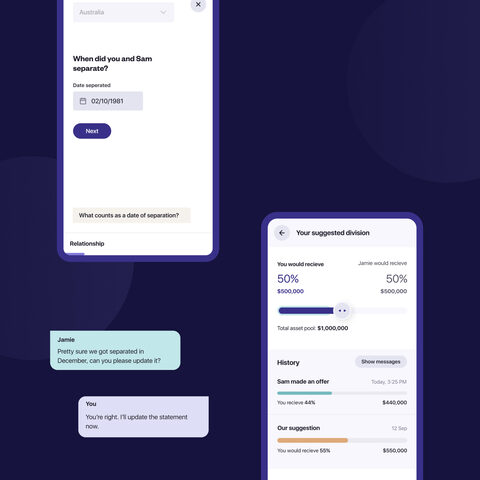
It is also the job that produces the work I am proudest of. Amica (and its international sister Civily) which helps separating couples divide their assets without going to court, was built on machine learning before anyone had heard of a large language model, because the problem demanded it and no product on any roadmap was going to solve it. Sweep, which lets a worker ask in plain language whether they are being paid properly, exists because wage theft is a very specific problem with very specific legal edges, and the award modelling behind it needs legal specialists and hand-curated data alongside the Fair Work APIs. Neither of those is a feature. Each is a piece of software built for exactly one problem and the people living with it. I hope this era lets us accelerate the spread of these products into the hands of users in hard to reach places, not just mass mono-markets. The software that serves humanity best lives at the edges, but it’s always bloody expensive to get it there.
Commercial software can afford to be generic because commercial problems are often generic. Community and government problems are not. They are shaped by legislation, by geography, by the particular people a service exists to reach and the particular ways those people have failed before. We have spent twenty years at Portable finding the gaps in Australia's system of public services, and the gaps are almost always in the places where a generic product met a specific human need and lost. More than a million people use systems we have built every day, and the ones that work best are the ones that were built for exactly the people using them, not some fart of a Salesforce installation.
That has always been expensive to do well. It is about to become much less so. That is not a threat to the work. It is the work, finally becoming possible at the scale the problems demand. Anthropic, Codex, OpenClaw, bring me beautiful, bespoke, life-changing software for everyone!
More people, in the right places
I know, before I get excited about the software, we need to talk about the jobs problem, because it’s a very real question. With these tools, we don’t need all of these engineers anymore, right?
Let’s start with what is actually happening here rather than what is being forecast in San Francisco. In July the Department of Employment and Workplace Relations published its AI and employment in Australia report, and it found no evidence of broad AI-driven upheaval in the labour market as of February this year. Employment for 20 to 24 year olds has grown slightly faster than for those over 25 since ChatGPT arrived in late 2022. Graduate unemployment is at historic lows. And the figure that I keep coming back to: software developer employment in Australia is up 25 per cent since November 2022. Not down. Up by a quarter. The report found some slowing in clerical and administrative roles that are heavily exposed, which is real and deserves attention, but net job availability in AI-exposed occupations grew by 10 per cent between 2019 and 2024.
I am not citing that to say the people warning about disruption are wrong. My honest read, from inside a business that hires, is that AI is neutralising hiring right now rather than cutting it. People are waiting to see. But I keep asking a question: when growth comes back, do we really believe companies will not hire? Every previous cycle says they will. A product manager can now spin up a version of a product in an afternoon, and that is extraordinary, but the distance from a scrappy idea to a thing that works for a thousand people in a hundred edge cases has not shrunk nearly as much as the demos suggest. I expect demand for the people who can close that distance to swing back hard. The deficit conversation takes the logic of the biggest generic software companies on earth, companies whose entire model is building one thing and selling it to everyone, and assumes it is the logic of the whole economy. If AI makes your engineers more productive and your product is generic, of course you stop hiring. That tells you something about generic products. It tells you very little about the rest of us.
If what I have described above is right, if the cost of building bespoke software is collapsing, then the demand for people who can do it well does not shrink. It explodes, because the number of problems worth solving with purpose-built software was always enormous and was only ever constrained by cost. The jobs are different jobs, and they sit in different eras of a person's working life than we are used to. They are less about typing the code and more about understanding the problem. Less about the generic skill of building software and more about the specific skill of building this software, for these people, under this legislation, in this town. They are broader roles, T-shaped ones, where someone combines a deep specialism with adjacent skills and uses the models to cover the ground in between. That is design research. It is service design. It is engineering that spends most of its time in conversation rather than in the editor. It is the kind of production and delivery work that keeps a bespoke thing alive and safe once it is in the world. These are the roles that generic software never needed many of, because generic software did not need to understand anyone in particular.
I’ve heard a lot of people talk about the Jevons Paradox, which is basically my thesis above and I have also heard from the likes of Bill Gates that this time around it’s different. I remain optimistic about the energy that will be unleashed. If we get beyond high inflation and high interest rates, we’ll start to see how this all really plays out.
Where we point the energy
Let me be honest about the one thing that could still spoil this. If the people building these systems for government carry over the platform-era instinct, one thing for everyone, roadmap for the company, then the models will simply make generic software cheaper and we will have missed the point entirely. If the people buying it keep procuring the way they have always procured, for the big safe product with the long reference list, the bespoke era will arrive in every sector except the ones that need it most. And if we let the models swallow the apprenticeship, the boring, formative, repetitive work through which juniors become seniors, we will raise a generation that can prompt but cannot judge.
But the real story is this. For twenty years I have watched good people in public services make do with software that was almost right. I have sat in rooms where a registrar explained, with enormous patience, why the form could not do the thing the legislation required, and where a caseworker kept a second spreadsheet because the system she was given had been built for a bank. I have watched communities at the edges of this country wait, and wait, for a product roadmap that was never going to reach them, because they were never a big enough market to be worth the sprint. Almost right has been the ceiling of our ambition for as long as I have been doing this. The money was never there to do better.
That ceiling is lifting. Software is about to become something closer to what it always should have been: a thing made for you, shaped to the exact contours of your problem, as particular as a key cut for a single lock. Beautiful, not in the way a glossy interface is beautiful, but in the way a well made tool is beautiful, because it fits the hand that holds it and does precisely the job it was made for and nothing else. The court registry gets the application flow the legislation actually describes. The regional council gets the permit process that matches the town. The worker in a kitchen in Dandenong gets a plain answer about whether she is being paid properly, in her own language, at eleven o'clock at night. None of these are features on anyone's roadmap. All of them are about to be possible, at a price that a council or a community legal centre can afford, built by people who have taken the time to understand the problem.
That is what I mean when I say this era is going to be great. Not great for the people selling the shovels. Great for the registrar, the caseworker, the family dividing a life without a courtroom, the kid in a town of four hundred people whose school finally gets the thing it needed rather than the thing that was available. The grand, intricate, humane software we always wanted to build and could never quite afford is coming into reach, and it will take more of us, not fewer, to make it well.
I will keep going to the round tables. I respect the people in those rooms and the worries they carry. But the next time the conversation turns to what we are about to lose, I am going to talk about what we are about to be able to make. The era of beautifully bespoke software is here. It is early. Lean into it.