Portable and pay equity accountability, Spring 2025
Since 2023, we have reviewed and reported on our internal pay equity every six months as an embedded discipline in how we lead and grow.
We could run the analysis and share with only our leadership team. We could share it only internally. Instead we choose to pull back the curtain, despite the taboo nature of salary discussion.
This September 2025 analysis builds on the reports before, the latest of which you can read here.
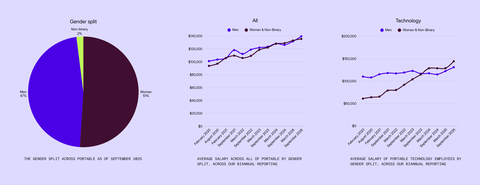
Within our technology team, the core result hasn’t changed. Since 2023, employees who identify as women or non-binary have earned slightly more on average than those who identify as men. That was true again in September 2025, in a discipline that remains heavily male-dominated industry-wide.
Across the organisation overall, however, the picture shifted slightly. While average salaries increased for all genders this cycle, the overall pay gap widened in favour of men. This reflects changes in team composition (including promotions, role changes, and attrition) and the ongoing impact of gender-skewed disciplines, rather than a single policy or pay decision.
In a small organisation, even a handful of movements can materially shift the data. That’s exactly why we measure consistently and report regularly.
In Australia’s technology industry, gender pay gaps remain the norm. Nationally, the median gender pay gap sits at around 19%, and many large technology employers report gaps of 15–25% in favour of men.
Technology is still one of the most gender-imbalanced disciplines at Portable, and across the industry more broadly. While representation isn’t yet where we want it to be, sustaining pay equity within the discipline is an important marker that our approach is working.
Pay equity is embedded into how we review salaries.
We conduct salary reviews twice a year. After the first round of reviews, we run a pay equity analysis to understand how pay differs across genders (including non-binary employees), levels and disciplines, and to identify whether any gaps have emerged or persisted.
Where needed, we make adjustments before finalising salaries. Once reviews are complete, we repeat the analysis to understand the overall outcome.
While we’re committed to transparency, we won’t be sharing the full report publicly. Why? Because protecting our people’s privacy matters. Portable isn’t a massive corporation, our teams are small enough that publishing detailed salary data could unintentionally reveal personal information. Instead we’re sharing key insights, trends, and the steps we’re taking to ensure real pay equity while keeping individual salaries confidential.
For the same reason, non-binary employees are included in the data for women. With our small sample size, this approach reflects both internal and external advice to protect privacy.
We’ll continue to run pay equity analyses every six months and report publicly on the results.
We’ll also keep working to improve gender balance across disciplines (particularly in technology and production) and to support equitable progression into senior and leadership roles.
Pay equity doesn’t happen by accident. It requires regular measurement, transparency, and a willingness to act when the data tells us we need to do better. This report is one snapshot in an ongoing body of work, and we’ll keep sharing what we learn as that work continues.